A Beginner's Guide to Telling Quartz, Quartzite and Glass Apart
A milky pebble from the beach, a polished offcut from a kitchen worktop, a chunky bead on a bracelet: three completely different materials that all get called quartz by someone. Some of the confusion is honest, because at arm's length they genuinely do look alike. Some of it is commercial, because "quartz" on a label sells better than "glass". The good news is that you can sort most of them out in a few minutes with a knife, a bottle and the underside of a mug.
Start with the tools you already have
You do not need a laboratory. A kitchen table, decent light and a handful of ordinary objects will cover almost everything:
- a steel knife, needle file or old chisel
- a glass bottle or a microscope slide with a clean, unused edge
- an unglazed porcelain tile — the raw foot ring on the bottom of a mug works well
- a magnifier, or the zoom on a phone camera
- a small torch
- a scrap of paper with a printed line on it
- a drop of dilute hydrochloric acid if you have it, or vinegar as a weak substitute
Work on a tray lined with newspaper, and do your scratching on an edge you do not care about. A test that ruins the specimen is not a useful test.
Hardness: the scratch test that settles most arguments
Hardness is measured on the Mohs scale, and only a few numbers matter here. A fingernail sits around 2.5, a copper coin near 3.5, window glass about 5.5, a good steel file around 6 to 6.5, and quartz right at 7. Quartzite is a rock rather than a single mineral, but it is mostly quartz, so it behaves the same way.
The rule is simple, and it only works in one direction: a harder material scratches a softer one, never the reverse.
The scratch test, step by step
- Drag a sharp point of the unknown firmly across the glass. A bright line that will not wipe away means the specimen is harder than glass — around 7 — which points to quartz or quartzite.
- Reverse it. Try to scratch the unknown with the clean edge of the glass. Glass cannot mark quartz. If a pale groove appears, the stone is softer than about 5.5 and is not quartz at all.
- Look at the debris. Quartz tends to throw up a small curved chip. Quartzite often leaves a fine white powder, because the line is breaking the grain boundaries rather than the grains themselves.
- Repeat on a second, clean spot. Weathered surfaces, resin coatings and tumbled skins all lie.
Press with intent but not with your whole weight, and wear glasses if you are bearing down on a sharp edge. Tiny chips travel further than you expect.
Streak: the quiet test nobody uses
Streak is the colour of a mineral's powder, and it is often more trustworthy than the colour of the stone itself. Unglazed porcelain has a hardness of roughly 6.5 to 7, which makes it a useful filter for quartz-like material. Rub the specimen firmly across the tile, then look at the tile rather than the stone.
Quartz leaves either nothing visible or a faint white smudge that blows away. A definite colour — reddish brown, ochre, grey-black — rules quartz out and usually points to an iron oxide or a dark silicate. Glass is softer than the tile, so the tile scratches the glass instead and the glass leaves no streak at all.
One caution: a white streak proves very little, because plenty of minerals streak white. Treat this as a filter, not a verdict.
Fracture, bubbles and the giveaway of grain
Hardness narrows the field. Texture finishes the job.
Quartz
Quartz has no cleavage, which means it never breaks along flat, shiny, parallel planes. Instead it fractures conchoidally — in smooth curved shells with sharp edges, a little like the inside of a shell. Those surfaces are usually translucent even when the stone overall is milky white. Look closely and you may spot small angular inclusions or cloudy patches arranged in flat planes, but not round bubbles. Well-formed crystals, of course, show flat six-sided prisms ending in points.
Quartzite
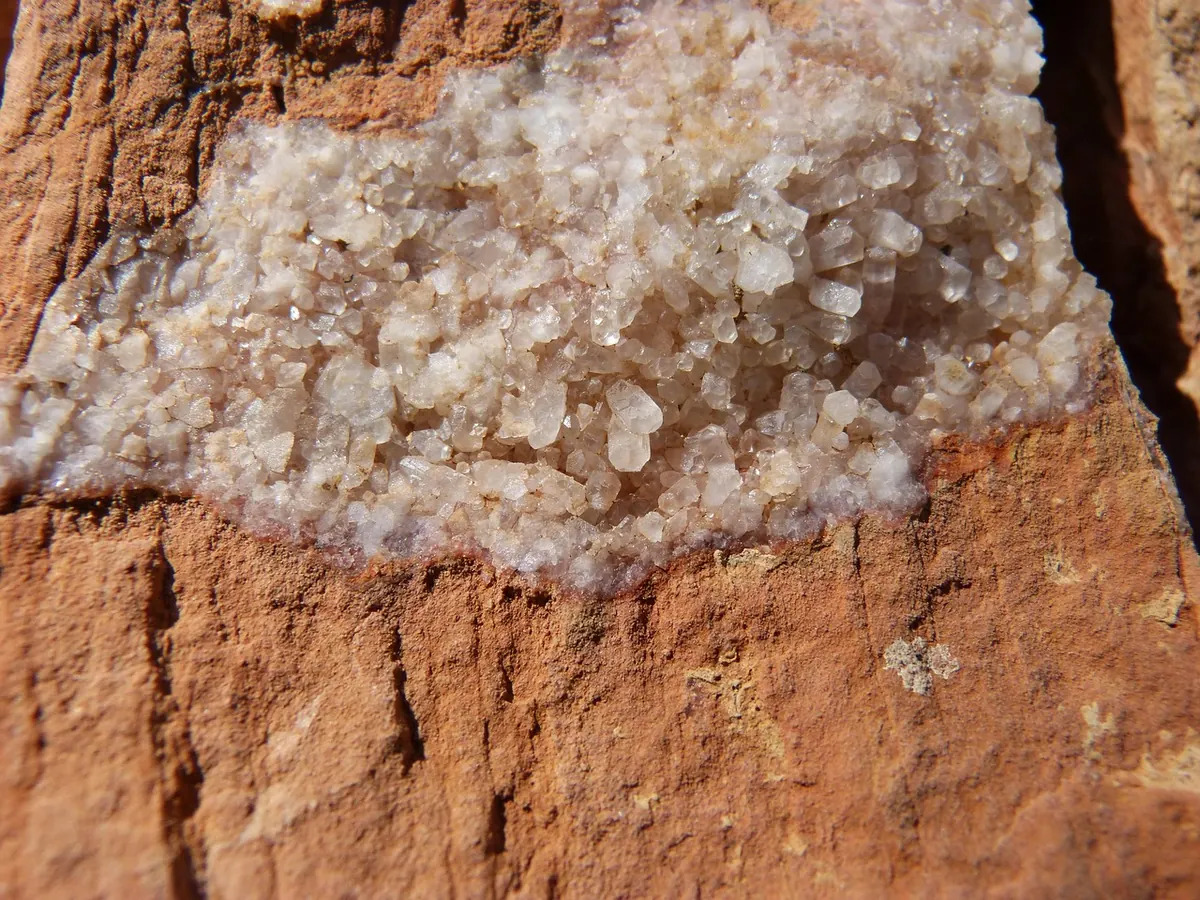
Quartzite is what happens when sandstone is cooked and squeezed until the quartz grains weld together. Break it and the crack runs through the grains rather than around them, giving a granular, sugary surface that sparkles evenly in the light — often with speckles of mica or iron staining, and sometimes faint bands. A quick check: rub the broken face with a wet thumb. Quartzite stays put. Sandstone, its softer cousin, sheds grit.
Glass
Glass is uniform. No grain, no crystals, just the same colour and texture all the way through. It fractures conchoidally as well, sometimes with fine ribbed lines near the edge, and it often carries round bubbles or faint swirls left over from manufacture. Tumbled glass can look convincingly like a polished pebble, but it usually feels slightly warmer in the hand. Quartz pulls heat away from your skin faster, so it stays cold for longer.
The double refraction trick
Clear quartz does something glass cannot. It splits light into two rays, so if you place a reasonably clear piece on a printed dot or line and look straight down through it, you will see two images. Glass shows one. The effect is strongest through pieces more than a centimetre thick and will not work on frosted, heavily included or opaque stones. Rotate the piece: quartz keeps doubling, and the separation shifts as you turn.
Two lookalikes worth ruling out
If your specimen is pale and smooth, marble and calcite deserve a mention. Both are far softer than quartz — a steel file bites them easily, while it slides off quartzite. The decisive test is acid. A drop of dilute hydrochloric acid fizzes busily on calcite and marble, and does nothing on quartz or quartzite. Dolomitic marble reacts weakly, or only when powdered. Vinegar works too, but slowly; give it a minute and watch for bubbles through a magnifier. Keep acid off your skin and eyes, and away from anything you value.
That test earns its keep in kitchen showrooms. A slab sold as quartzite that fizzes is marble wearing the wrong label, and it will etch if you leave lemon juice sitting on it.
Feldspar is the other common mix-up. It is slightly softer than quartz, so a file will catch it, and it breaks along flat cleavage faces rather than curving shells. And "engineered quartz" worktops are not rock at all: they are crushed quartz bound with resin. They scratch glass much like the real thing, but they are uniform, resinous and easily scorched. Test on an offcut, never on a fitted surface.
Putting it together in five minutes
- Look before you touch: grain, bubbles, cleavage planes, swirls.
- Scratch both ways with glass.
- Streak the specimen on unglazed porcelain.
- Add a drop of acid if the stone is pale and smooth.
- Check double refraction if you have a clear piece.
If two or three of those tests point the same way, trust them. Keep a few known samples on a shelf — a clear quartz point, a quartzite pebble, a lump of bottle glass — and compare them side by side. Your eye learns the difference faster than any chart, and a scratched bottle is a cheap price for a straight answer.