Five Common Mistakes When Buying Quartz Worktops in the UK
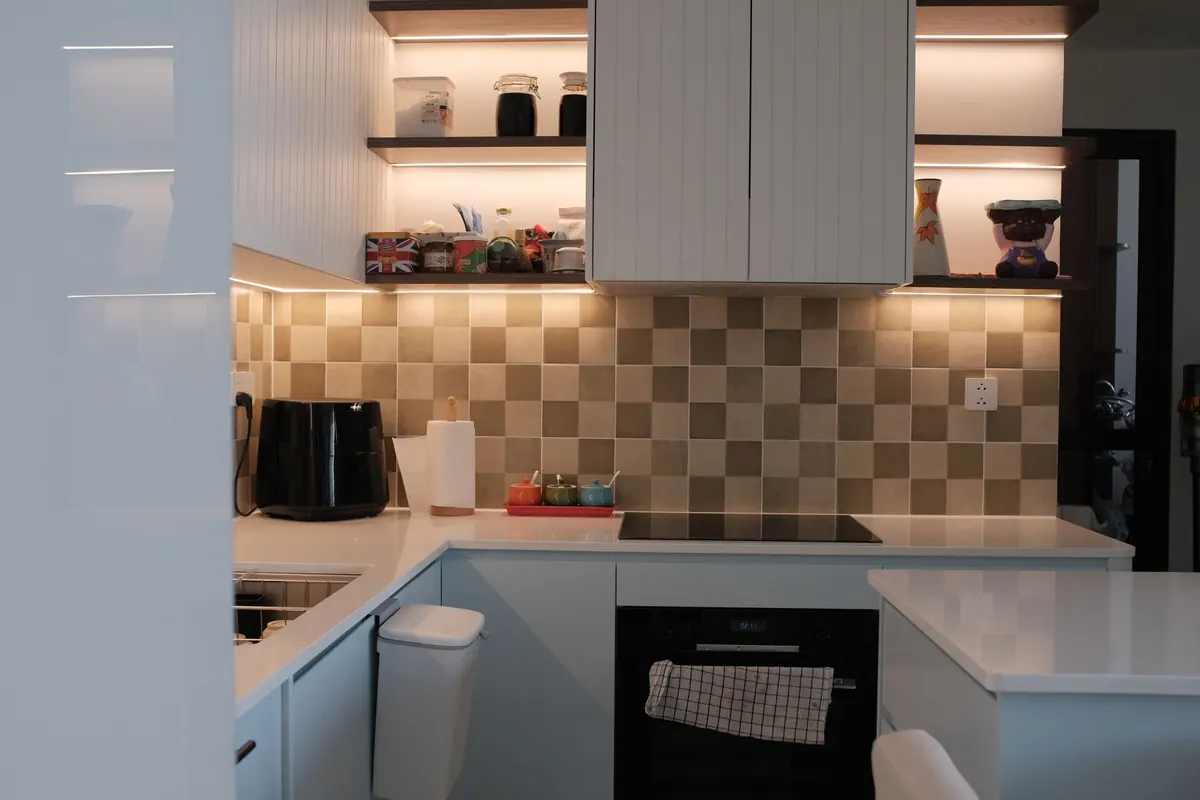
Buying a quartz worktop is one of the more expensive decisions in a kitchen project, and one of the least forgiving. A boiler can be swapped out later; a worktop templated badly, cut for the wrong sink or scorched by a hot pan is a much more painful problem. Most of the complaints fabricators hear afterwards come down to five things, and every one of them is avoidable if you know what to look for before you place the order.
Templating from a drawing rather than the room
Templating is the stage where a fabricator measures your actual cabinets — fitted, levelled and fixed — and produces a template the worktop is cut from. The mistake is booking it too early, or accepting a quote based on a kitchen plan alone.
Walls are almost never square. Plaster bows, corners that measure 90 degrees on a drawing can easily be 88 on site, and a run of units can sit a few millimetres out over three metres. Cut to the drawing and one end of the worktop sits tight to the wall while the other leaves a gap, or the front edge runs out of parallel with the cabinets. A proper template also picks up every socket, tap, hob and upstand joint.
Expect a deliberate gap of a few millimetres where the worktop meets the wall. That is filled with silicone or hidden by an upstand, and it allows for movement.
Before the templater arrives
- Cabinets level, screwed together and fixed back to the wall.
- End panels and appliance housings installed, not leaning in a corner.
- Sink, tap and hob on site if they are undermount or flush-fit.
- Old worktops removed and enough floor space to work.
Change your mind about the sink after templating and you will usually be paying for a new piece of stone, because the cut-out is made for one specific model.
Sink cut-outs: the detail that causes the most call-backs
Undermount sinks need more thought than most buyers give them. The stone around the opening is thin, so the fabricator has to leave enough rail between the cut-out and the front edge, and think about how the weight is carried.
Sharp internal corners concentrate stress and can crack months after installation, which is why cut-outs are made with radiused corners and polished. A heavy cast iron or ceramic sink is best supported on a cradle or brackets fixed inside the cabinet, with the silicone seal acting as a water seal rather than a structural joint. Make sure the tap hole sits in solid stone, not above the sink opening.
Cut-outs should be done in the workshop, not on your kitchen floor. On-site cutting with an angle grinder is dusty, less accurate and can affect your warranty.
Assuming quartz is heat-proof
Quartz is not the same as granite. Engineered quartz is mostly crushed stone bound with resin, and resin is what reacts when you rest a hot pan on it. The result is usually a dull white bloom, sometimes yellowing, and occasionally a crack from thermal shock as one area expands faster than the rest.
Keep a trivet or chopping board beside the hob, and never put a slow cooker, air fryer or hot baking tray straight down. Light surface scorching can sometimes be polished out, but a crack cannot be repaired invisibly. Heat damage is also one of the things manufacturers commonly exclude from warranty cover, so treat the surface as heat-resistant, not heat-proof.
The sealing myths
Two opposite myths do the rounds. One says quartz must be sealed every year like granite. The other says sealing is entirely pointless. The truth sits in the middle, and it matters because it changes how you clean the surface.
Quartz is effectively non-porous, so it does not need the annual sealing routine that a porous natural stone does. Oil, wine and coffee will not soak deep into the surface. It is not, however, stain-proof: the resin can pick up pigment if a spill is left, particularly on pale colours. A turmeric or red wine spill left overnight on a white worktop can leave a faint shadow.
Impregnating sealers are often offered as an add-on. They are not necessary for the stone, and some leave a haze or a slightly tacky film on a polished surface. What keeps quartz looking new is simpler:
- Wipe daily with warm water and a drop of washing-up liquid.
- Use a dedicated quartz or stone cleaner for greasy marks.
- Blot coloured spills rather than wiping them across the surface.
- Skip bleach, abrasive cream and scouring pads, which dull the finish.
Choosing a colour from a photograph
Samples are small and photos are edited. A soft grey on a phone screen can look much darker in a north-facing kitchen with one window, and "white" quartz often carries a warm or cool cast that only becomes obvious next to your cabinet doors and splashback.
Quartz is produced in batches, so veining can shift slightly between runs. If you fall for a particular slab in a showroom, ask whether your worktop can be cut from slabs reserved from that batch, and whether you can view them before cutting. Direction matters too: a marble-effect surface with strong veins looks quite different with the veins running across the room rather than along it, and book-matched pairs need planning so the pattern mirrors properly at the joint.
Take a sample home. Look at it in the morning, at dusk and under your actual lights, next to the floor and the units. Choose taps and handles afterwards, not before.
Before you place the order
None of these mistakes is dramatic on its own. Together they turn a straightforward job into an expensive one.
- Units fitted, levelled and fixed before templating is booked.
- Sink, tap and hob chosen and on site, with cut-out details confirmed in writing.
- Agreed who supplies brackets or a cradle for a heavy sink.
- Asked what to expect on heat and staining, and read the warranty exclusions.
- Viewed the actual slab or a large sample in your own kitchen light.
- Templating date, installation date and payment schedule confirmed in writing.
A worktop is a fitted product, so your remedies if something goes wrong depend on the contract and the manufacturer's terms. Photograph any damage as soon as you spot it, raise it with the fabricator in writing, and take proper advice if it turns into a dispute.
Photo: Huy Phan / Pexels